
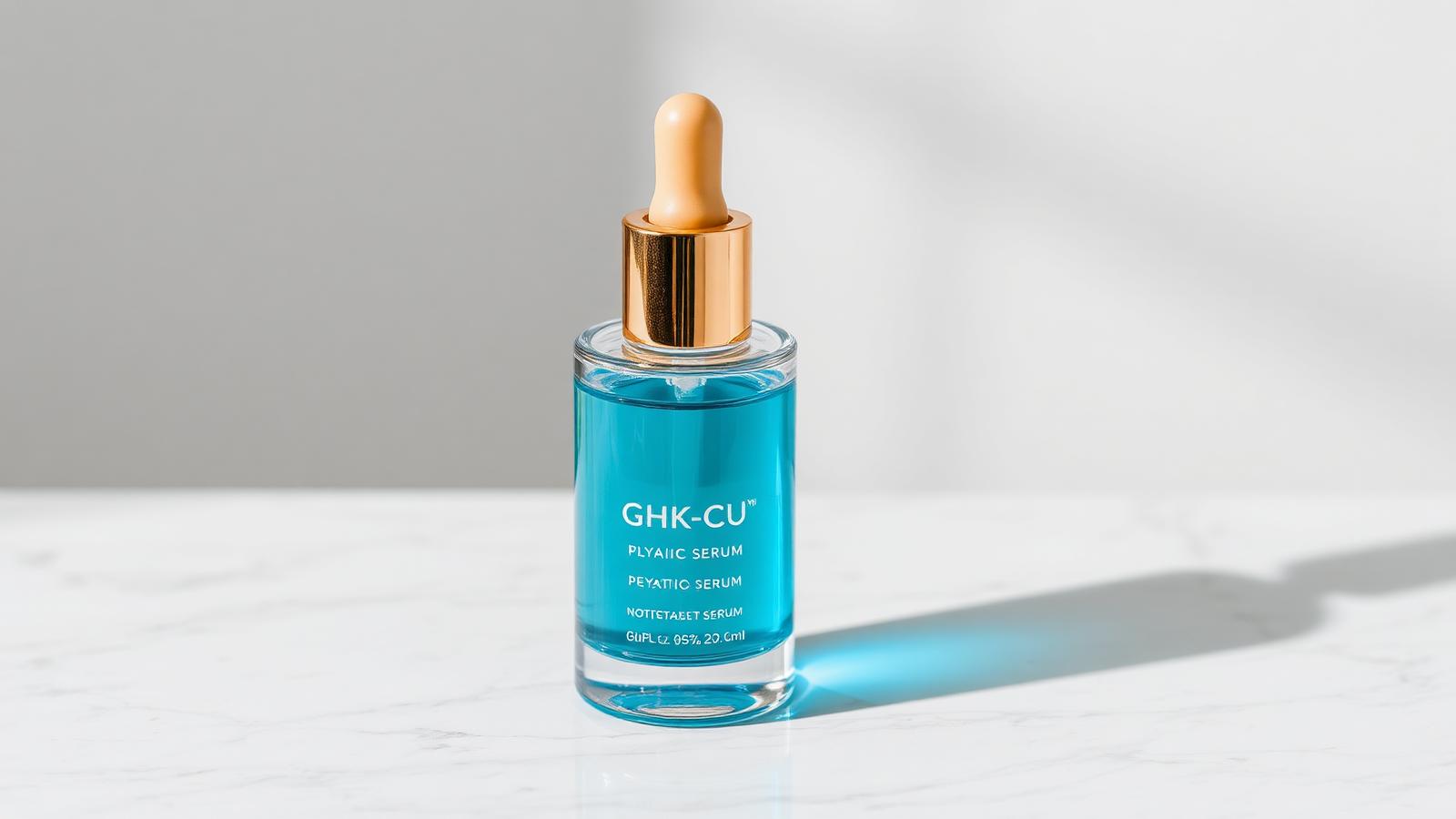
For years, if you were losing your hair, the conversation started and ended with finasteride and minoxidil. (2025 study on combined oral minoxidil and finasteride in men with androgenetic alopecia) But lately, we've been seeing a lot of buzz around GHK-Cu, a copper peptide that naturally exists in your body. It started out in the research world for its ability to heal wounds and fix skin elasticity, but honestly, its potential for hair restoration is what has caught our attention in the clinic. [1]
The science of GHK-Cu
Think of GHK-Cu (glycyl-L-histidyl-L-lysine) as a tiny signal molecule that tells your cells to get back to work. Your body makes plenty of it when you're twenty, but levels take a nosedive as you get older. By the time you're sixty, you're looking at about a third of what you used to have. Since it’s so vital for repair, that decline is a big reason why skin gets paper-thin and hair follicles start to give up. [2]
How it actually helps your hair
- It helps beef up follicle size and keeps individual hairs in the 'growth' phase longer.
- Crucial nutrients get to the root easier because it improves blood flow across the scalp.
- It helps knock down the chronic inflammation that usually causes follicles to shrink and shrivel.
- The area around the follicle base gets much-needed support from increased collagen and proteoglycan production.
What the data tells us
In the lab and in early clinical trials, topicals containing this peptide have shown real promise for thickening the hair shaft and slowing down shedding. Look—the studies aren't as massive as the ones for Big Pharma staples like minoxidil, but the safety profile is fantastic. It’s not necessarily a replacement for the classics, but it's an incredible teammate for them. [3]
The perks beyond new growth
- It’s great for calming down a dry, itchy, or overly sensitive scalp.
- You can use it alongside minoxidil to get better results without doubling up on side effects.
- Since it’s a topical peptide, you don't have to worry about systemic hormonal issues.
- If some gets on your face, it actually helps with fine lines and better skin tone.
Why our patients are asking for it
I see a lot of folks who just can't stomach the side effects of finasteride but aren't ready to give up on their hair. GHK-Cu is the middle ground they've been looking for. It doesn't mess with your hormones; instead, it just improves the environment where your hair grows. It’s an easy, low-stress add-on to any morning routine. [1]
Adding it to your routine
Usually, we have patients apply the solution once a day to a clean scalp. You have to be patient, though. You’ll likely see your scalp health improve in about a month or two, but the actual hair changes take three to six months to really show up. We often layer this into a broader plan that might include other therapies to get the best possible outcome.
My final take
I’ll be straight with you: GHK-Cu isn’t a miracle cure that grows a full head of hair overnight. However, it is one of the most logical, science-backed tools we've seen in a long time. Whether you’re using it as a standalone or as part of a 'cocktail' approach, it provides a solid way to fight thinning without the typical trade-offs.
Available across Florida
Reset My Vitality is a Florida-licensed telehealth practice. The treatments covered in this guide are available to patients statewide, with medication shipped directly to your door. Explore the program for your city:
- Hair Loss in Miami, FL
- Hair Loss in Miami Beach, FL
- Hair Loss in Fort Lauderdale, FL
- Hair Loss in West Palm Beach, FL
- Hair Loss in Boca Raton, FL
- Hair Loss in Orlando, FL
- Hair Loss in Tampa, FL
- Hair Loss in Jacksonville, FL
- Hair Loss in Naples, FL
Key Clinical Studies
A short, responsible summary of recent peer-reviewed research relevant to this topic. This is for education only, not medical advice.
Regenerative and Protective Actions of the GHK-Cu Peptide in Human Skin
International Journal of Molecular Sciences · 2018
Key finding: Topical GHK-Cu applied for 12 weeks increased skin density and thickness, reduced wrinkles and laxity, stimulated collagen, and supported hair follicle health in human studies.
Why it matters: Provides human-trial evidence for using GHK-Cu in skin repair, anti-aging, and adjunctive hair-growth protocols.
View studyCopper peptides (GHK-Cu) are a powerful hair-growth promoter
International Journal of Molecular Sciences · 2023
Key finding: GHK-Cu upregulated genes involved in tissue repair, antioxidant defense, and wound healing across human and preclinical models, and promoted hair-follicle activity.
Why it matters: Helps explain the broad regenerative effects reported with GHK-Cu peptide therapy.
View studyScientific References
Peer-reviewed studies and reviews cited in this article.
- [1]Liu et al. Copper peptides (GHK-Cu) are a powerful hair-growth promoter. 2023. View study