
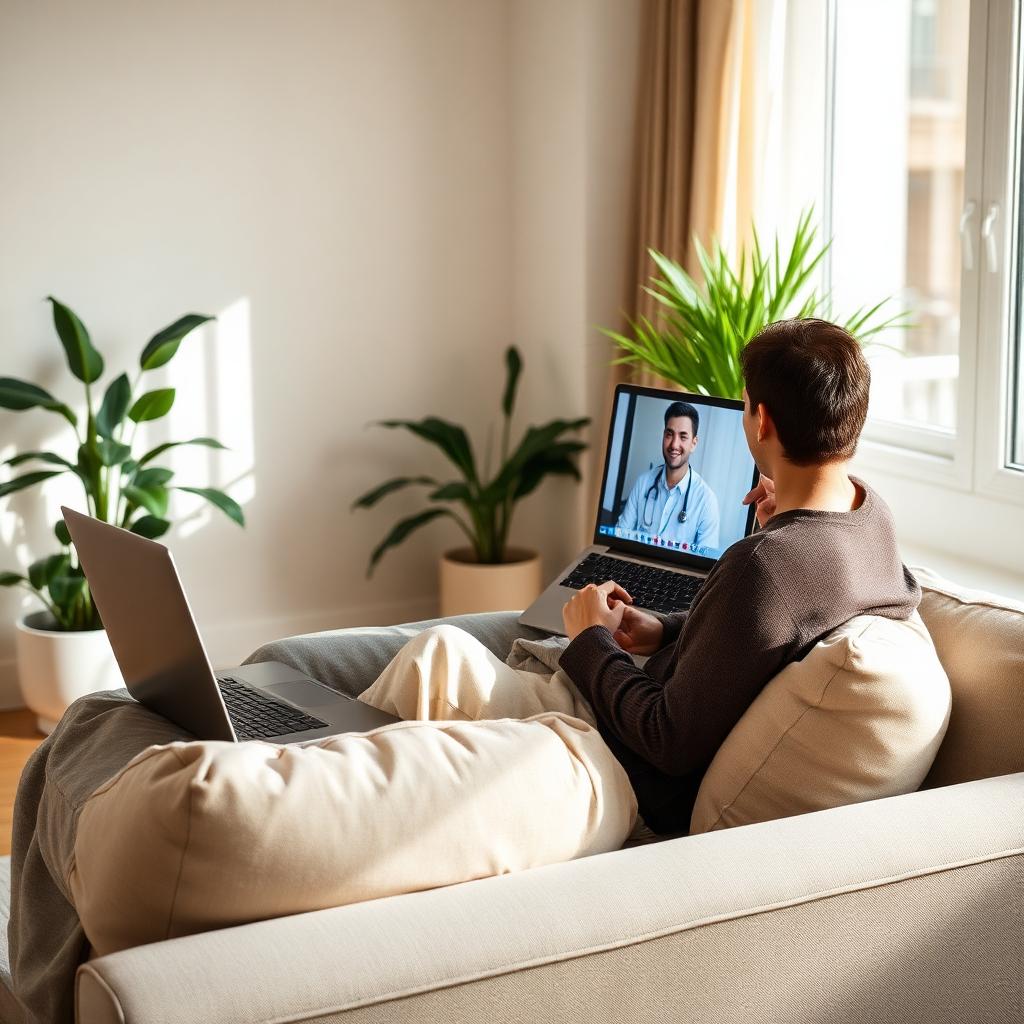
Honestly, the traditional doctor’s office design is a relic. It was built for paper charts, local pharmacies, and a time when people could just take a half day off work for a 12-minute check-up. In my 13 years of practice, I've realized that for prescription-based care, telehealth isn't some 'lite' version of medicine. It's actually faster and more consistent. You're getting the exact same evidence-based treatment from the same licensed clinicians, just without the commute. [1]
1. We're talking days, not weeks
Across the country, the average wait if you're a new patient is about 26 days. If you're looking for psychiatry? Good luck; you're usually looking at two or three months of waiting. With telehealth, I usually see patients for an intake within 24–72 hours. When we're dealing with things where momentum is everything—like weight loss, depression, or hair loss—that quick start is often what keeps a patient from just giving up entirely. [2]
2. Care happens in your living room
Forget the drive across town or the hunt for a parking spot. There's no awkward waiting room or trying to reschedule your whole life around a commute; you just hop on a secure video call from your couch. For the working parents and shift workers I see, this isn't just a convenience—it’s the only reason they’re able to stay consistent with their treatment in the first place. [3]
3. Lower costs for everyone
- We don't have to charge facility fees because we aren't paying for massive waiting rooms or front-desk staff.
- Pricing is transparent and flat—no surprise bills in the mail three weeks later.
- Your medications ship right from licensed pharmacies at prices that actually make sense compared to brand-name markups.
- You save the 'invisible' costs like gas, childcare, and unpaid time away from your desk.
4. Follow-ups aren't an afterthought
Most chronic prescriptions need a little tweaking—a dose adjustment here or a question about a side effect at week three. In a classic office setting, that usually means a fresh copay and another two-week wait for an appointment. In my clinic, we handle this through secure messaging or a fast video check-in within hours. It's simple: patients who can actually get their questions answered stay on their treatment, and that's how you get results. [1]
5. Real clinicians, real standards
To be clear, the people you see via telehealth are the same U.S.-licensed MDs, NPs, and PAs you’d find in a brick-and-mortar building. We use the same prescribing guidelines, the same lab panels, and the same clinical evidence. The medication arriving at your door comes from a licensed U.S. pharmacy just like any other. The medicine doesn't change—only the logistics do.
6. Privacy is a priority
Look—for things like ED, hair loss, or mental health, the waiting room itself can be a massive barrier. Some folks just don't want to run into their neighbor while they're waiting for a weight loss consult. Telehealth gets rid of that layer of anxiety. Everything we do is HIPAA-compliant, and the packaging that shows up at your door is discreet and unbranded.
When you still need to go in person
Telehealth is a tool, but it's not the only tool in the box. If you need a physical exam, imaging, an infusion, or have a severe mental health crisis, you belong in a physical office. A clinician with integrity will tell you that honestly and refer you to the right place rather than trying to treat something that shouldn't be handled over a screen.
The bottom line
Whether it's weight loss, ketamine therapy, or peptides, telehealth offers better access and more frequent follow-up at a lower price point. It streamlines the process so you can focus on actually feeling better. Honestly, the only thing we've really removed is the waiting room.
Available across Florida
Reset My Vitality is a Florida-licensed telehealth practice. The treatments covered in this guide are available to patients statewide, with medication shipped directly to your door. Explore the program for your city:
- Telehealth in Miami, FL
- Telehealth in Miami Beach, FL
- Telehealth in Fort Lauderdale, FL
- Telehealth in West Palm Beach, FL
- Telehealth in Boca Raton, FL
- Telehealth in Orlando, FL
- Telehealth in Tampa, FL
- Telehealth in Jacksonville, FL
- Telehealth in Naples, FL
Backed by Research
A short, responsible summary of recent peer-reviewed research relevant to this topic. This is for education only, not medical advice.
Telehealth Interventions for Postpartum Depression: Systematic Review and Meta-analysis
JMIR Mental Health · 2021
Key finding: Telehealth-delivered mental health interventions produced clinical outcomes comparable to in-person care, with high patient engagement.
Why it matters: Backs a fully online care model with shipped medication and direct messaging for consistent follow-through.
View studyTelehealth for the Longitudinal Management of Chronic Conditions: Systematic Review
Journal of Medical Internet Research · 2022
Key finding: Telehealth interventions for chronic conditions showed outcomes similar to in-person care, with improved access and reduced visit burden.
Why it matters: Supports telehealth as a credible delivery model for ongoing treatments like GLP-1 therapy, ED care, and mental health.
View studyScientific References
Peer-reviewed studies and reviews cited in this article.
- [1]Telehealth for the Longitudinal Management of Chronic Conditions: Systematic Review. JMIR. 2022. View study
- [2]Trends of consultation time, waiting time, and satisfaction in primary care: Systematic review and meta-analysis. 2025. View study
- [3]Telehealth Interventions for Postpartum Depression: Systematic Review and Meta-analysis. JMIR. 2021. View study